About the transcript
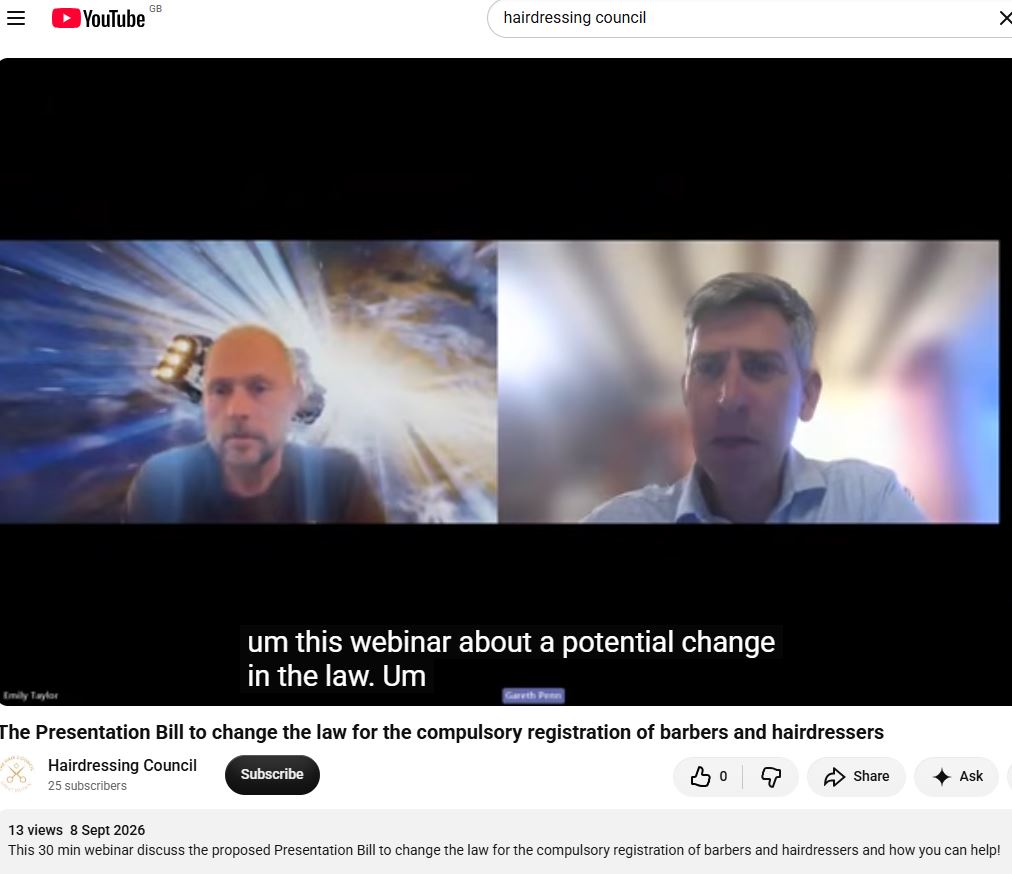
The webinar was hosted by the Hairdressing Council on the evening of Monday 7 September 2026 and posted to the Council's public YouTube channel on 8 September under the title "The Presentation Bill to change the law for the compulsory registration of barbers and hairdressers." The transcript used here was taken from the public recording and is condensed; timestamps refer to the recording. Phrases in quotation marks are verbatim. Everything else is a close paraphrase, and the recording is the authority. If the Council believes any passage misrepresents what was said, the correction address is at the foot of this page.
Executive Summary
- The event: The Council's Registrar and a Dorset training-business owner told registrants that Vikki Slade MP will present a Barbers and Hairdressers (Registration) Bill on 14 September 2026, and asked them to lobby their own MPs
- The framing: The change was described as "simply about changing one word in the Act: voluntary → compulsory." The 1964 Act contains no such word, and Parliament removed compulsion from the Bill deliberately in 1964
- The history: "This has been going on since the 60s." It has been going on since 1936, in both Houses, and Parliament has declined it each time — see the century-long record
- The government: The Registrar said "Government now understands" the case. On the day the video was posted, the responsible minister answered written questions on mandatory registration and licensing with "no current plans for additional regulation"
- The mechanics: A presentation bill is a first reading with no debate, no vote and, usually, no published text. The speakers acknowledged as much: "symbolically important"; "no guarantee the law will change"
- What was not mentioned: How the Council is currently constituted under the Act's Schedule, whether it publishes accounts, and its own Registrar's written confirmation that it is not a public authority
Who Was Speaking
Gareth Penn is Registrar and Chief Executive of the Hairdressing Council, the body created by the Hairdressers (Registration) Act 1964, which trades as the Hair & Barber Council. He is also Managing Director of Good Salon Guide Ltd, which the Council lists as a sponsor.
Mike Taylor introduced himself as a former chairman of the British Barbers Association who has "been lobbying for recognition and licensing for many years." He runs a barbering training business in Dorset and is described by the trade press as founder of "The Barber Council", which the Hairdressing Council's own website says "is part of The Hairdressing Council." He is a constituent of Vikki Slade, MP for Mid Dorset and North Poole, and has been "discussing this with Vikki for about two years."
The Council has a direct financial interest in the outcome. Registration currently costs £75 a year (£55 for Graduate or Associate grades; trainees free). A statute compelling every practising hairdresser and barber in Great Britain to register with it would convert a voluntary membership of a few thousand into a compulsory levy on an occupation of several hundred thousand. Neither speaker mentioned this.
What Was Said
| Time | Speaker | Claim or statement |
|---|---|---|
| 1:33 | Penn | "We are as close as we have ever been to achieving the change in the law we have all worked hard for" |
| 2:13 | Penn | "The Hairdressing Council was established in 1964. We are now in 2026. This is real progress" |
| 5:00 | Taylor | Another colleague raised the issue with Caroline Nokes, who "has shown interest" |
| 5:44 | Taylor | Slade "has secured a slot on 14 September to introduce a presentation bill… It will be brief, but symbolically important" |
| 6:51 | Penn | Slade "will introduce a Barbers and Hairdressers Registration Bill — a bill to make provision for compulsory registration" |
| 7:26 | Penn | "It doesn't contain the detailed framework — that comes later. This is about signalling intent" |
| 10:45 | Penn | "Vicky needs eight supporters for Monday"; template correspondence to be provided |
| 12:03 | Taylor | "This has been going on since the 60s and we are close"; issues to raise with MPs: "apprenticeships, VAT, health and safety, illegal operators" |
| 15:17 | Penn | "This is not about nationality or style of barbering. The issue is untrained, unqualified operators" |
| 15:56 | Penn | "To be registered, you must be trained — Level 2 or equivalent" |
| 20:20 | Penn | "Government now understands this is about public protection, tax avoidance, and illegal trading — not about hitting a percentage of voluntary registrants" |
| 21:45 | Penn | "Trade bodies like FHA and the Hair Council already require qualifications and insurance" |
| 22:26 | Penn | "This stage is simply about changing one word in the Act: voluntary → compulsory" |
| 23:12 | Penn | "There is no guarantee the law will change" |
| 25:38 | Penn | "Most clients assume barbers and hairdressers must be licensed. When told they are not, they are shocked" |
| 28:07 | Penn | "Mandatory registration must be part of wider reform discussions, including VAT" |
What the Record Says
1. "Since the 60s"
The Council dates the campaign from its own creation. The parliamentary record does not. A registration bill had its first reading in the Commons on 29 July 1936; Lords bills followed in 1937 and 1938; a Ten-Minute Rule bill in 1939; a full Second Reading debate in 1949, in which the Home Office declined to support compulsion because no public-health authority had asked for it and local Acts already covered hygiene. The 1964 Act was the outcome of that thirty-year effort, and Parliament removed compulsion from it. Every generation since has asked again — 1978, 2015, 2025, 2026 — and been given the same answer. The full dated record, with Hansard references, is on the century page.
This matters because the webinar presented the bill as the culmination of a sixty-year effort that is now, at last, close to success. It is the tenth decade of the same request. "As close as we have ever been" was also true in 1938, 1949 and 1964.
2. "Changing one word"
"Simply about changing one word in the Act: voluntary → compulsory"
The word "voluntary" does not appear in the Hairdressers (Registration) Act 1964
Registration under the 1964 Act is voluntary not because the Act says so but because the Act contains no offence of practising unregistered. To make registration compulsory, Parliament would have to add what the 1949 Bill contained and the 1964 Act does not: an offence provision, penalties, exemptions, a definition of the activity being prohibited, transitional arrangements for those already practising, an enforcement body, powers of entry and an appeal route. The 1949 Bill needed twenty-one clauses to do that. The Home Office objected in 1949 that the proposed controls were stricter than those applying to doctors and architects, and in 1964 Parliament took the compulsion out. A trade minister told the Commons in November 1978 that "the only main change made" to the 1964 Bill in passage "was that the mandatory regulation proposed in the Bill was changed to a voluntary one."
Mr Penn acknowledged at 7:26 that the bill "doesn't contain the detailed framework — that comes later." That is an accurate description of a presentation bill. It is not consistent with "one word."
3. What a presentation bill is
Under the Commons' Standing Orders, any Member may present a bill by giving notice and standing at the appropriate moment to name it. There is no speech, no debate and no vote; the bill is deemed read a first time and a day is named for second reading. The presenting Member's name and up to eleven supporters' names are printed on the back. The text need not exist at presentation and very few such bills are ever printed, let alone debated. Both speakers said as much: "brief, but symbolically important" (5:44); "signalling intent" (7:26); "no guarantee the law will change" (23:12).
The "eight supporters for Monday" (10:45) are the names that will appear on the back of the bill. Those names are the first hard information the campaign will have produced, and this site will publish them when the Order Paper does.
Caroline Nokes
Mr Taylor said a colleague had raised the matter with Caroline Nokes. Ms Nokes is a Deputy Speaker. Deputy Speakers do not sponsor or support private Members' bills, and her name will not appear on this one. Her having "shown interest" should not be read as support.
4. "Government now understands"
The recording was posted on 8 September 2026. On the same day, Kate Dearden, the minister responsible for the sector and chair of the Personal Care Sector Roundtable, answered five written questions on the sector from three Members. To Lee Anderson's questions on the merits of mandatory registration, licensing and statutory qualifications (UINs 21752 and 21755) the answer was: the government has "no current plans for additional regulation for hairdressers and barbers, but we remain open to evidence," registration under the 1964 Act "remains voluntary," and "the introduction of additional regulation would need to be carefully considered." To his question on giving local authorities greater powers (21754): "no current plans." Luke Evans (21848, self-employment and pensions) and Liz Jarvis (22186, salons in Eastleigh) were referred to the Roundtable. That is the fifth statement of the position in eighteen months, after the written answer of April 2025, the Commons Library briefing of June 2025 and the written answer of January 2026.
The claim that government has been persuaded the issue is "tax avoidance" also needs a source. Tax is HMRC's business; the 1964 Act gives the Council no function in relation to it, and section 14 is explicit about the boundary: "The Hairdressing Council shall have no powers as regards negotiating questions of service, charges, wages or conditions of employment of hairdressers as between employer and employees or otherwise." HMRC's own measured VAT compliance gap for hairdressing over 2009–2023 is £22.7m — see the CBI Economics report deconstruction.
5. "Already require qualifications and insurance"
The Act entitles one class of person to registration. Section 3(1) requires an apprenticeship or a course approved by the Council under section 4, and "a reasonable and sufficient standard to qualify him to practise." Section 2 defines the register as containing "all persons who are entitled under the provisions of this Act to be registered." The only other route the Act ever contained, section 3(2), was a grandfather clause for anyone with three years' practice before 1 January 1966; it could apply to no one who entered the trade after 1963, and it was repealed as spent in 2004.
Set against that, the Council's own public pages offer Trainee (free), Graduate and Associate (£55) and full (£75) grades, and the 2015 adjournment debate, drawing on the Council's briefing, described the register as open "either through qualification or six years practising as a hairdresser." Any route to the register that is not section 3(1) — years of practice, a trainee grade, an associate grade — is the Council's, not Parliament's. The Council's rule-making power under section 6 covers the form of the register, the evidence required and the fees; it cannot create an entitlement the Act does not contain.
"Level 2 or equivalent" (15:56) is therefore not what the register currently requires; it is what the Act requires, applied selectively. And a compulsory scheme built on section 3(1) as it stands would exclude every practising hairdresser and barber without an apprenticeship or approved course behind them. Either the bill needs a new grandfather clause — another reason "one word" is wrong — or the Council intends to go on operating routes the Act does not provide, now under compulsion. Neither speaker mentioned the question.
6. "Most clients assume barbers and hairdressers must be licensed"
They may well. It is worth asking where the assumption comes from. The Council's website offers members a "certificate of State Registered achievement", describes itself as "the only statutory authority in the sector", and states that it is "tasked by Government." Its Registrar has confirmed in writing that the Council is not a public authority. A public that believes hairdressers are licensed has been told so most consistently by the body that would like them to be.
What Was Not Said
Thirty minutes on a bill to make registration with the Hairdressing Council compulsory did not address:
- how the Council is currently constituted under the Act's Schedule, given that at least one of its appointing bodies was dissolved in January 2023;
- whether the Council publishes accounts, or why it declined a request for them under section 13(3) by citing section 10, which concerns certificates;
- what compulsory registration would cost each practitioner, or the sector, or who would enforce it;
- what would happen to the many thousands currently practising without an apprenticeship or approved course — the only people the Act entitles to register — and whether the bill would contain a grandfather clause, as the 1964 Act did;
- that the Council's members are appointed by the trade bodies named in the Act, so that compulsory registration would give those bodies control of entry to the occupation;
- that a Deputy Speaker cannot support the bill, or which MPs will.
The Question Before the Bill
Before Parliament is asked to compel several hundred thousand people to register with a body, it is entitled to know that the body is constituted as the law requires, publishes its accounts, and is independent of the trade organisations that appoint to it. The webinar asked registrants to lobby their MPs. It did not equip them to answer any of those questions.
What Happens Next
On 14 September the Order Paper will show the bill's long title, the presenting Member and the names printed on its back, and a date for second reading. This page will be updated with each. The names will show which MPs have put theirs to the proposal, and each of them will receive from this site a short briefing with the record set out above. Registrants who take up the Council's invitation to meet their MP may find it useful to take the same briefing.
Conclusion
The webinar was candid about what the bill is — a signal, with no framework, no guarantee and no debate — and inaccurate about what it would take. "One word" is a slogan, not a description of legislation. The history was shortened by thirty years; the government's position was reversed; and the questions that ought to come before any compulsion — constitution, accounts, independence, cost — were not raised.
The Council asked its registrants to speak to their MPs. This site would encourage them to do so, and to ask the Council the questions above first.
Source Documents
- Hairdressing Council, "The Presentation Bill to change the law for the compulsory registration of barbers and hairdressers", YouTube, posted 8 September 2026 (webinar held 7 September) — recording; Wayback Machine capture of the page, 11 September 2026 (the Wayback Machine does not preserve YouTube video streams); a copy of the recording, the transcript and the screenshot are held in the source archive
- Hairdressing Council website (homepage, "About us", registration fees and grades), captured September 2026
- BarberEVO, "UK Barbers Could Soon Face Mandatory Registration", September 2026 (bill title; Mike Taylor's role)
- Hairdressers (Registration) Act 1964, full text including Schedule; revised text and as enacted, legislation.gov.uk (sections 2, 3, 6, 14, 15; section 3(2) repealed 2004)
- HC Deb 11 February 1949 vol 461 cc718–744 (Second Reading; Home Office objection)
- HC Deb 27 November 1978 vol 959 cc10–11 (mandatory changed to voluntary in passage)
- HC Deb 7 January 2015, Hairdressing (adjournment debate; register open by qualification or six years' practice)
- Written answers, 8 September 2026, Kate Dearden MP (Department for Business, Innovation, Science and Trade): Lee Anderson, UIN 21752, 21755 and 21754; Luke Evans, 21848; Liz Jarvis, 22186 (Commons Daily Report, 8 September 2026, pp.81–82)
- House of Commons Standing Orders (Public Business), presentation of bills
- A Century-Long Struggle for Regulation in Hairdressing — the dated parliamentary record, the Schedule, and the Council's constitution
- The CBI Economics Report: A Methodological Deconstruction
Full source archive: data.salonlogicpro.co.uk/sources/
Every claim in this analysis can be verified against the cited primary sources. Challenge our analysis: analysis@salonlogicpro.co.uk